News & Insights
The Next Energy Advantage: Why Storage, Hybrid Systems and Digital Operations Are Becoming One Investment Decision
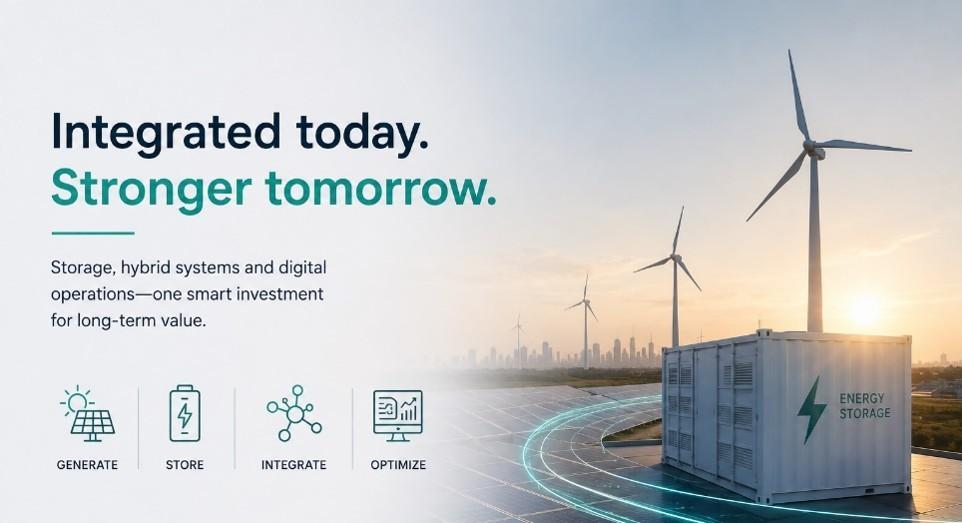
The next phase of energy infrastructure will be defined by how intelligently different technologies work together. Solar and wind have transformed the economics of power generation. Battery storage is adding flexibility. Digital systems are changing how assets are monitored, maintained and optimized. For investors and developers, these technologies are increasingly becoming parts of one infrastructure decision — and the question is shifting from which technology to invest in, to which combination of technologies can deliver the strongest performance, resilience and long-term asset value.
The Economics of Energy Are Changing
Renewable power has moved decisively into the mainstream of global energy investment. According to IRENA's Renewable Power Generation Costs in 2024, 91% of newly commissioned utility-scale renewable projects produced electricity at a lower cost than the cheapest new fossil-fuel alternative. At the same time, battery storage economics have changed dramatically — IRENA reports that utility-scale battery storage costs declined by approximately 93% between 2010 and 2024, from USD 2,571/kWh to USD 192/kWh. This changes the investment equation. Storage can increasingly be evaluated alongside generation from the earliest stages of project development, allowing developers to think about the performance of the whole energy system rather than individual technologies.
1. Storage Is Becoming Infrastructure
Battery Energy Storage Systems (BESS) are moving beyond their early role as supporting technology. They can provide multiple forms of system value: storing excess generation, shifting electricity across different periods of demand, supporting grid stability and improving the flexibility of renewable generation. A solar project produces electricity according to the availability of sunlight. An integrated solar-plus-storage project introduces another variable: time. Energy can be generated at one point and delivered when its value to the system is higher. For developers and investors, that flexibility can influence project configuration, revenue potential, grid interaction and ultimately the investment case.
2. Hybrid Systems Change the Development Question
The traditional approach to project development often begins with a technology — solar, wind, gas or storage. The emerging approach begins with the requirement of the energy system: what level of reliability is required, what is the demand profile, when is electricity most valuable, and how much flexibility is needed? The answer may increasingly be a hybrid architecture combining renewable generation, storage, conventional generation or other technologies. This is particularly relevant in the GCC, where large-scale renewable resources coexist with growing industrial demand, expanding cities, water infrastructure and increasingly energy-intensive digital economies. Hybridization therefore becomes more than an engineering choice — it becomes an investment design decision.
3. Digital Operations Create a Second Layer of Value
Building an advanced energy asset is only the beginning. Once operational, the asset begins generating another valuable resource: data. Generation patterns, equipment temperatures, battery performance, degradation rates, maintenance records, weather conditions and thousands of operating signals can provide continuous insight into asset performance. Digital twins, predictive maintenance and advanced performance analytics allow operators to convert this information into decisions. Instead of relying primarily on scheduled intervention, operators can increasingly identify emerging performance issues, optimize maintenance activities and understand how individual components are influencing the performance of the wider system. For long-term infrastructure investors, relatively small improvements in availability, efficiency and maintenance strategy can accumulate across decades of operation — digitalization connects operational performance directly with asset value.
4. Integration Becomes the Competitive Advantage
As individual technologies mature, competitive advantage increasingly moves toward integration. A high-performing solar module has value. An efficient battery has value. A sophisticated analytics platform has value. But the greater opportunity lies in designing these elements as an integrated infrastructure system. That requires decisions across engineering, commercial structuring, technology selection, financing and operations to be made with the complete lifecycle in mind. The developer's role therefore expands — it is increasingly about creating an architecture in which technology, capital and operations reinforce one another.
5. Lifecycle Economics Matter More Than Initial Cost
Energy infrastructure is designed to operate for decades. Evaluating projects primarily through initial capital expenditure provides only part of the investment picture. The stronger question is: what will this asset cost, produce and be worth throughout its operating life? That assessment can include energy output and availability, storage degradation and replacement cycles, operating and maintenance expenditure, technology efficiency, digital optimization opportunities, future flexibility, revenue resilience, and residual asset value. A technology with a higher initial investment may create superior economics if it increases availability, extends useful life, reduces operating expenditure or provides additional system flexibility. This is why lifecycle value is becoming central to sophisticated energy investment decisions.
From Individual Assets to Intelligent Energy Systems
The future of energy infrastructure is becoming increasingly interconnected. Generation determines how energy is produced. Storage determines when it can be delivered. Hybrid architecture determines how technologies complement each other. Digital operations determine how effectively the asset performs over time. And investment discipline determines whether these capabilities translate into sustainable economic value. The emerging model can be expressed simply: Generate → Store → Integrate → Monitor → Optimize → Create Long-Term Value. For energy developers, the opportunity lies in connecting these capabilities from the beginning — because the next competitive advantage in energy will come from building the most intelligent system, not just owning the best individual technology.

News & Insights
Let's Build the Future of Energy Together
Whether you're planning a new development, expanding infrastructure, or exploring strategic opportunities, our team is ready to support your project with tailored energy solutions.