News & Insights
From Energy Demand to Investable Infrastructure: What Makes an Energy Project Bankable?
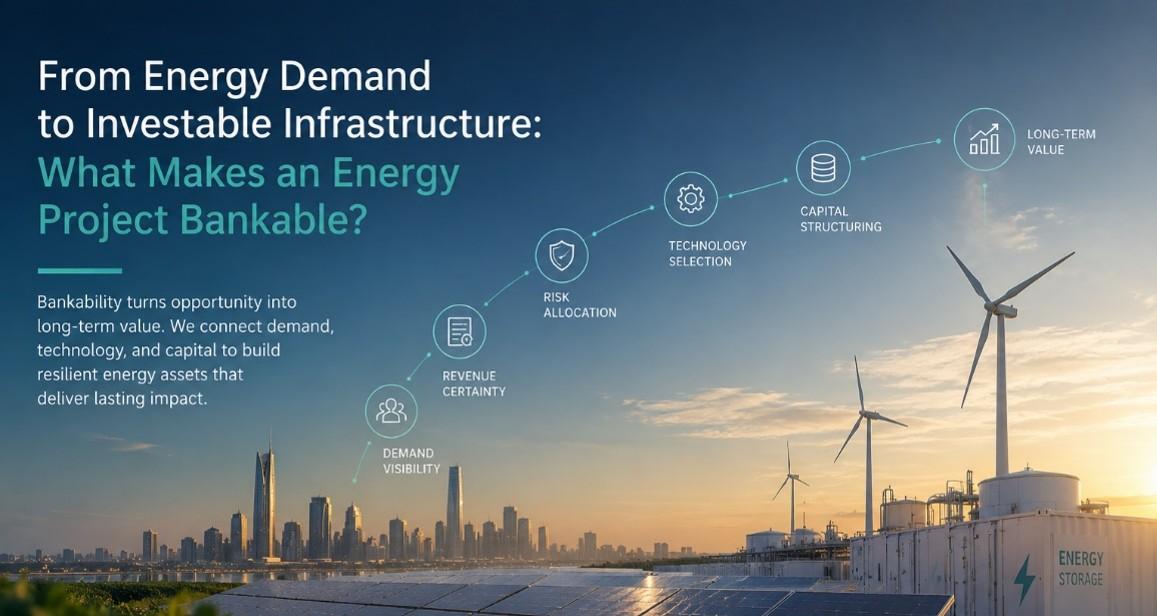
Energy demand creates opportunity. Bankability turns that opportunity into infrastructure. Across the UAE and GCC, energy systems are evolving alongside industrial expansion, population growth, digital infrastructure, water demand and the transition toward increasingly diversified energy systems.
For developers and investors, the critical question is therefore moving beyond how much new capacity is required. The more important question is: Can that demand be converted into an asset capable of attracting capital, managing risk and creating value over decades? This is where bankability begins.
Bankability Starts Before Financing
A bankable energy project is more than a technically feasible project with an attractive return. It is an investment proposition in which the technical solution, revenue model, contractual structure, risk allocation and financing strategy work together. IRENA identifies project readiness, credible offtake arrangements, sound financial structures, experienced project teams and effective risk management among the fundamental elements that determine renewable energy project bankability. These elements need to be established during project development — well before financial close — making development discipline one of the most important drivers of infrastructure value.
1. Start With Long-Term Demand
Every strong energy investment begins with a clear understanding of demand. Who requires the energy? How predictable is that requirement? How will demand evolve over the life of the asset? And what strategic or economic activity sits behind it? For power, water and utility infrastructure, the quality of demand directly influences the quality of the investment case. Industrial expansion, data centres, urban development, large infrastructure programmes and new economic clusters can all create significant energy requirements. The role of the developer is to translate that requirement into a project with a defined capacity, technology solution, revenue framework and development pathway. In other words, megawatts alone do not create an investment case. Predictable demand does.
2. Build Revenue Certainty
Infrastructure requires significant upfront capital and generates returns over long periods. The visibility and quality of future cash flows therefore become central to financing. In power projects, long-term Power Purchase Agreements (PPAs) remain an important mechanism for creating this visibility. The World Bank describes the PPA as the primary contract supporting the project's main revenue stream and highlights its importance to commercial viability and bankability. Yet the existence of a PPA is only the beginning. Investors and lenders assess the strength of the offtaker, tariff structure, payment mechanisms, contract duration, indexation, termination provisions and the allocation of demand and market risks. The objective is to create a revenue structure capable of supporting the asset through different operating and economic conditions.
3. Allocate Risk to Where It Can Be Managed Best
One of the most important principles in project finance is also one of the simplest: risk creates value when it is understood, priced and allocated deliberately. Construction risk may sit with an experienced EPC contractor. Operating performance may be managed through clearly defined O&M obligations and performance standards. Offtake risk may be addressed contractually. Technology, regulatory, currency, fuel supply and interface risks each require their own mitigation structure. The World Bank's PPP guidance emphasizes that project risks should generally be allocated to the party best positioned to manage them efficiently. Balanced allocation creates something more valuable: confidence in the project's future cash flows — and confidence is ultimately what attracts long-term capital.
4. Select Technology Through an Investment Lens
Technology decisions increasingly shape both the performance and the economics of energy infrastructure. Solar PV, wind, battery energy storage systems, hybrid configurations, hydrogen technologies and digital asset-management tools are expanding the range of solutions available to developers. The strongest technology, however, is the one that fits the project. Technology selection should therefore consider proven performance, local operating conditions, scalability, maintainability, supply-chain resilience, integration requirements and lifecycle economics. For GCC projects, this also means understanding how technology performs under regional environmental and operational conditions — and where localization can strengthen long-term capability.
5. Structure Capital Around the Asset
Once demand, revenue and risk are clearly defined, capital can be structured around them. The appropriate combination of equity, project finance, institutional capital and strategic partnerships will vary according to the project's maturity and risk profile. For long-term infrastructure, the objective extends beyond securing funding. The capital structure should support the project through construction, commissioning and operations while maintaining appropriate resilience under different performance scenarios. This is why financing strategy belongs inside project development rather than at the end of it. Capital follows structure.
Beyond Financial Close
Financial close is an important milestone. Long-term infrastructure value, however, is created over the decades that follow. Operational performance, predictive maintenance, digital monitoring, asset optimization and disciplined lifecycle governance can materially influence availability, operating costs and asset value. For long-term owners, the investment thesis therefore continues after commissioning. The project evolves from a development opportunity into an operating infrastructure asset — one that must continue delivering technical performance, reliable cash flows and strategic value.
From Opportunity to Infrastructure
The next generation of energy investment across the UAE and GCC will require more than capital and technology. It will require the ability to connect: Demand → Technology → Commercial Structure → Risk → Capital → Operations → Long-Term Value. That connection is what transforms an energy requirement into investable infrastructure. And increasingly, it is where the real work of energy development begins.

News & Insights
Let's Build the Future of Energy Together
Whether you're planning a new development, expanding infrastructure, or exploring strategic opportunities, our team is ready to support your project with tailored energy solutions.