News & Insights
Beyond Batteries: The Technologies That Could Define the Next Generation of Energy Infrastructure
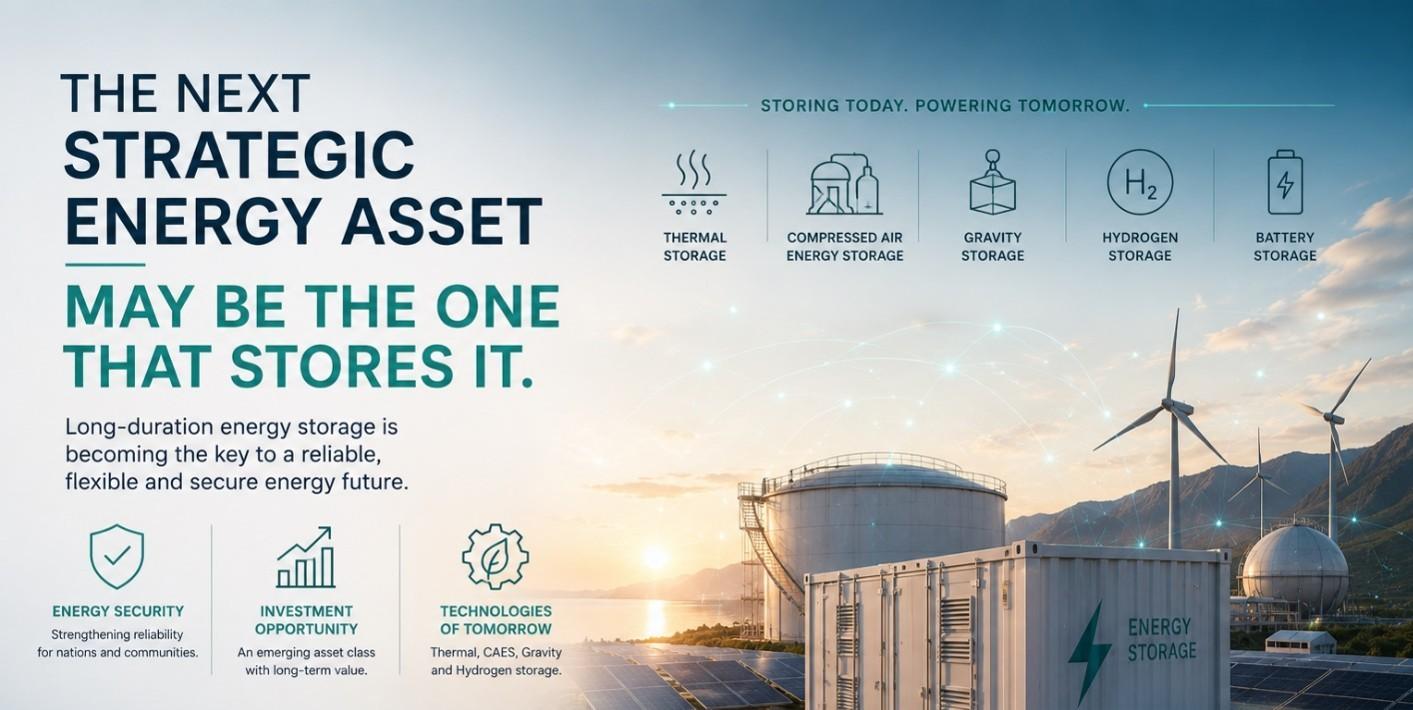
The next major energy opportunity may not come from generating more electricity. It may come from making energy available exactly when the economy needs it. As renewable capacity expands, governments, utilities and investors face a new infrastructure question: how can energy systems maintain reliability when generation and demand occur at different times? This is moving long-duration energy storage (LDES) from a technology discussion into an infrastructure and investment discussion.
Beyond Lithium-Ion
Lithium-ion batteries have transformed short-duration energy storage. But future power systems will increasingly require technologies capable of storing energy for much longer periods. IRENA identifies several emerging long-duration storage pathways.
Thermal Storage
Thermal storage captures energy as heat using materials such as molten salts, rocks or other thermal media, then converts or uses it when required. This pathway can be integrated with various energy and heat applications, particularly in industrial environments and projects that require high levels of operational flexibility.
Compressed Air Energy Storage
Compressed Air Energy Storage (CAES) uses surplus electricity to compress air for storage, which can later be released to generate power. Economic viability varies by location, project scale and available infrastructure. For developers, site suitability becomes a critical factor in determining whether this technology can be converted into a bankable project.
Gravity Energy Storage
Gravity energy storage converts electricity into gravitational potential energy that is recovered when power is needed. Multiple technical designs exist in this space, and investment value will depend on the ability to demonstrate performance, reach commercial scale and achieve competitive economics across the asset's life.
Hydrogen as an Energy Storage Medium
Hydrogen storage uses renewable electricity to produce hydrogen through electrolysis, allowing energy to be stored over extended periods and potentially used across power, industry, transport and other applications. From an infrastructure perspective, value lies in the ability to connect electricity with different demand sources within a broader energy system.
Technology Alone Does Not Create an Asset Class
For investors, the appeal of long-duration storage technologies is not measured by novelty alone. The more important questions concern storage duration, efficiency, operating life, scalability, operating cost, site requirements, supply-chain maturity, revenue model and regulatory framework. Technological innovation becomes an investment opportunity when it can solve a clear economic problem within a fundable and scalable model.
Why This Matters to Governments
For governments, storage is increasingly connected to energy security. A system capable of generating clean electricity is valuable. A system capable of generating, storing and strategically dispatching that electricity is more resilient. This distinction becomes increasingly important as economies add data centres, advanced manufacturing, industrial clusters and other electricity-intensive infrastructure. The UAE Energy Strategy 2050 already targets a tripling of renewable energy contribution by 2030 and national investment of AED 150–200 billion over the same period. As renewable capacity grows, the infrastructure that provides flexibility around that capacity becomes increasingly strategic.
Why This Matters to Investors
For investors, the opportunity extends beyond identifying the technology with the lowest cost. The stronger question is: which technologies solve an infrastructure constraint that will become more valuable over time? That requires evaluating storage duration, scalability, location, technology maturity, revenue mechanisms, operating economics and regulatory frameworks. Some technologies will remain unsuitable for certain markets. Others may become strategic infrastructure assets. The investment advantage will belong to those capable of identifying that distinction early.
The Next Infrastructure Layer
The energy transition is creating an infrastructure layer between generation and consumption. Its purpose is flexibility. Its technologies may include batteries, thermal storage, compressed air, gravity systems and hydrogen. And its value will increasingly be measured through reliability, resilience and the ability to deploy energy when it creates the greatest economic value. For governments, this is an energy-security question. For investors, it is an emerging asset class. For energy developers, it is a development opportunity. The next strategic energy asset may be defined not by how much energy it generates — but by how intelligently it can store and deliver it.

News & Insights
Let's Build the Future of Energy Together
Whether you're planning a new development, expanding infrastructure, or exploring strategic opportunities, our team is ready to support your project with tailored energy solutions.